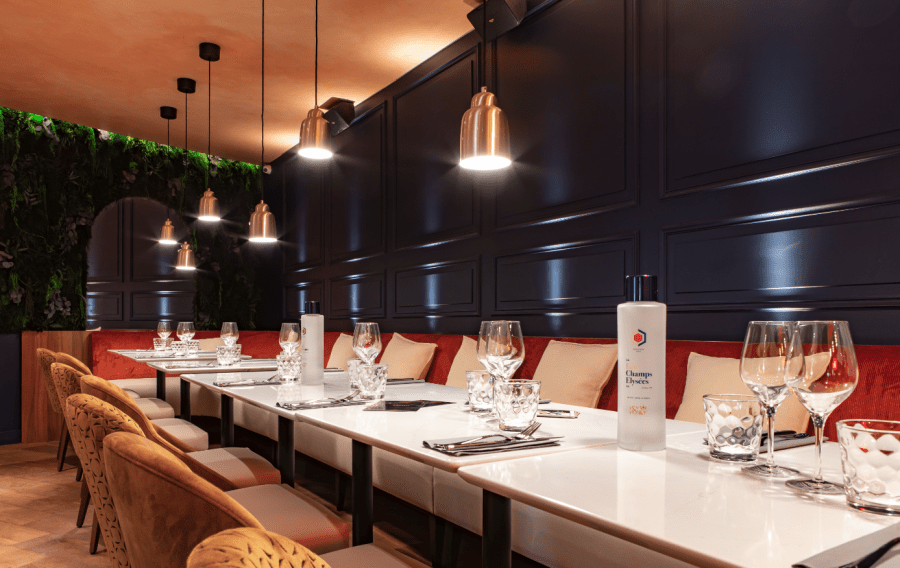

The Nectar Paris restaurant introduces chef Keiichi Shinohara

The Nectar Paris restaurant welcomes the prestigious chef Keiichi Shinohara

A toasty note comes through first. Then a livelier, almost unexpected acidity. The vegetable flavours come to the fore, with a slight bitterness lingering on the palate. Nothing seeks to dominate. Instead, everything seems to find its balance.


At Nectar, the cuisine is now experienced in this way: through successive sensations, sometimes familiar, sometimes harder to pinpoint.


In the heart of the 9th arrondissement, Nectar Paris is opening a new chapter with chef Keiichi Shinohara. Born in Tokyo in 1973, he brings a highly personal vision of contemporary French cuisine, shaped by his Japanese heritage and, above all, by an almost instinctive attention to ingredients.


More than just a change to the menu, his arrival heralds a new culinary identity: precise without being rigid, creative without seeking to show off, capable of creating a dialogue between French technique and hojicha, white sesame, Japanese plum or tamarind when the ingredient calls for it.


A cuisine where you taste before you try to understand.

The Nectar Paris restaurant introduces chef Keiichi Shinohara ©The Nectar Paris restaurant introduces chef Keiichi Shinohara

What is the new culinary identity of Nectar Paris?

It all starts with the ingredient.

Not as an element placed in the centre of the plate, but as a starting point that the chef seeks to explore in all its nuances. One texture can evoke another. A less obvious part of an ingredient can become the basis for a juice, an infusion or a condiment. A cooking method reveals a sweetness; a hint of acidity then comes along to bring it to life.

This desire to work with the ingredient as thoroughly as possible sets the tone for Nectar’s new cuisine.

For Keiichi Shinohara, precision never overshadows instinct. On the contrary, it provides a framework for it.

Each dish is built around a balance of elements: acidity to add depth, bitterness to prolong a flavour, vegetable notes to bring freshness, and roasted notes to create depth. Japanese influences appear in subtle touches – in a seasoning, a fragrance or a pursuit of simplicity.

They do not serve to disguise French cuisine.

Rather, they shift it ever so slightly.

Perhaps this is where the most interesting aspect of this new identity lies: the sense of recognising something before a single detail shifts the dish in a different direction.

This philosophy underpins the various dining experiences on offer at the Nectar restaurant.

At lunchtime, the approach is ‘bistronomic’: contemporary cuisine designed to combine precision, indulgence and spontaneity.

In the evening, the pace changes. Dishes are served in two distinct experiences: Pollen’, a four-course menu available in a vegetarian option, and Apis’, a seven-course menu. Two ways of giving greater scope to the chef’s narrative, the seasons and the pairings of food and drink.


Nectar restaurant ©Nectar restaurant

The art of Franco-Japanese fusion by Keiichi Shinohara

The term ‘fusion’ can sometimes conjure up images of cuisine characterised by obvious contrasts: two traditions brought together on a single plate, each vying for recognition.

With Keiichi Shinohara, the approach is more subtle. Japan appears less as a theme than as a sensibility.

Hojicha can lend its toasty notes. White sesame, a deeper roundness. A Japanese plum, a different kind of acidity. Tamarind, a fruity zing.

These touches are only meaningful when they find their place in harmony with the main ingredient.

The aim, therefore, is not to wonder, with every mouthful, where France ends and Japan begins. Rather, it is to understand how two culinary cultures can come together without losing their natural character.

At the table, this nuance makes all the difference.

Nectar restaurant ©Nectar restaurant

From Tokyo to the Nectar Paris restaurant: the journey of an exceptional chef

Born in Tokyo in 1973, Keiichi Shinohara is one of those chefs whose cuisine naturally reflects the dialogue between two cultures.

His Japanese perspective does not distance him from the French culinary tradition. On the contrary, it allows him to approach it with a different sensibility: a particular focus on precision, seasonality, balance and what can be taken away rather than added.

His career has led him to develop a deeply personal style of French cuisine, punctuated with references to his native Japan, without ever turning these into a systematic signature.

At Nectar, this philosophy finds a particularly natural outlet.

The Maison Mère restaurant has never viewed the gastronomic experience as a mere succession of courses. The dining room, the service, the drinks, the lighting and the rhythm of the dinner all play a part in what one takes away from a meal.

Keiichi Shinohara’s cuisine reinforces this approach.

A dish may begin with the freshness of a vegetable, evolve into a deeper flavour, and then leave a hint of bitterness or a toasty note on the palate. The accompanying wine pairing may prolong this sensation, contrast with it, or offer a different interpretation.

The experience then becomes a shared one.

The kitchen and the dining room do not tell two parallel stories: they create the same moment.

Nectar restaurant ©Nectar restaurant

Cuisine that evolves with the seasons

A culinary identity is only worthwhile if it can evolve. At Nectar, seasonality ensures that the cuisine never becomes a repetitive formula. It requires us to observe what is appearing, what is disappearing and what is at its peak. In this way, the produce has the final say.

This approach also explains why certain Japanese flavours never become routine. Hojicha, sesame or plum are not signature ingredients that are used indiscriminately. Their inclusion depends on the balance sought at any given moment. This ensures the menus remain dynamic.

‘Pollen’, a four-course menu, offers a more focused exploration of this world and can be adapted for vegetarians. ‘Apis’, a seven-course menu, leaves more room for transitions and the progression of the meal.

In both cases, the idea remains the same: to let the dishes respond to one another rather than treating them in isolation.

The food and drink pairings extend this exploration by also playing on contrasts, resonances and sensations.

This is a cuisine that one does not simply come to taste.

But to experience.


Nectar by Maison Mère ©Nectar by Maison Mère

FAQ – Nectar Paris restaurant

What characterises contemporary Franco-Japanese cuisine?

Contemporary Franco-Japanese cuisine generally combines techniques or ingredients from both cultures without necessarily seeking a visible fusion. It may play on stocks, fermentation, seasonings, umami, acidity or roasted notes, whilst retaining a structure inspired by French cuisine.

Why do some chefs seek to use an ingredient in its entirety?

Using an ingredient in its entirety allows chefs to explore a wider range of textures and flavours whilst making the most of parts that are sometimes overlooked. Depending on the ingredient, these parts can be used to create a jus, an infusion, a condiment or a garnish, adding further cohesion to the dish.

What is the difference between a four-course and a seven-course tasting menu?

A four-course menu generally offers a more concise experience, whilst a seven-course menu allows the chef to develop greater nuance and transitions. At the Nectar Paris restaurant, ‘Pollen’ is a four-course menu, with a vegetarian option, whilst ‘Apis’ offers a seven-course experience.

Where can you sample Keiichi Shinohara’s cuisine in Paris?
Keiichi Shinohara is now in charge of the kitchen at Nectar, Maison Mère’s restaurant located at 7 Rue Mayran in Paris’s 9th arrondissement. His cuisine combines seasonal produce, French precision and subtle Japanese influences, for both lunch and dinner.


MM Family

Become a member

Guests, neighbours, artists, artisans, collaborators and personalities meet, share and exchange around exclusive events such as private parties, openings,
secret workshops and dinner with friends.

And, above all, each member of the MM family can benefit from extra-special offers that are exclusive to our community!